
A perfume can smell different from its first spritz to its final dry-down: bright top notes fade, while heart and base notes reveal more of its character. To learn how to choose a perfume, start with a fragrance family you enjoy, then give the scent time to develop on your skin before deciding if it feels right.
A promising first impression can turn into something softer, warmer or entirely unexpected. That’s why choosing a fragrance involves more than liking its opening notes. This guide explains how scent families and notes unfold, how to test perfumes thoughtfully in store and what to look for in online descriptions. Use these details to make a considered choice that suits your taste and the impression you want to leave.
Key Takeaways
- Match a fragrance’s character to the mood or impression you want to express, rather than relying on its first impression alone.
- Use scent families as a starting point: fresh, floral or green notes can feel lighter, while woody, spicy and resinous notes offer more depth.
- Notice how top, heart and base notes unfold; the dry-down can reveal whether a perfume truly suits you.
- In store, narrow your choices before trying them on skin; when browsing online, read the note descriptions to picture how the fragrance may develop.
How Do Perfume Notes Affect Your Choice?
A perfume’s notes shape its character, and your impression may change as it develops. Fragrance can cause allergic reactions or irritation. Stop using it if you react, and seek medical advice for persistent or severe symptoms.
Match scent character to your style
Choose a scent character that reflects how you like to present yourself. If your style is understated, try clean or powdery notes; for a more expressive mood, consider warm spices or woods. Think about occasions, too: a soft fragrance may suit a quiet day, while a richer scent can feel right for an evening. Don’t rely on personality labels alone; your comfort matters more than a category.
Explore your scent profile
Use a fragrance quiz as a starting point, not a verdict. Select notes you already enjoy, such as citrus, rose or vanilla, then compare its suggestions with scents you’ve liked before. Personal taste and scent perception vary: a note that feels fresh to one person may seem sharp to another. A quiz can reveal patterns, but your own response should guide your choice.
- List scents you enjoy in daily life, such as orange peel, fresh flowers or cedar. These familiar references can help you recognise notes you might welcome in a perfume.
- Consider the season and your preferred longevity. A lighter eau de toilette may suit warm days, while a deeper scent can feel more comforting in cooler weather.
- Try a promising fragrance on your skin and notice its character as it changes. If you still enjoy it later, it may be a stronger candidate for your signature scent.
Fragrance families
Use fragrance families to narrow your options before comparing individual perfumes. Their shared qualities provide a useful guide, not a strict rulebook.
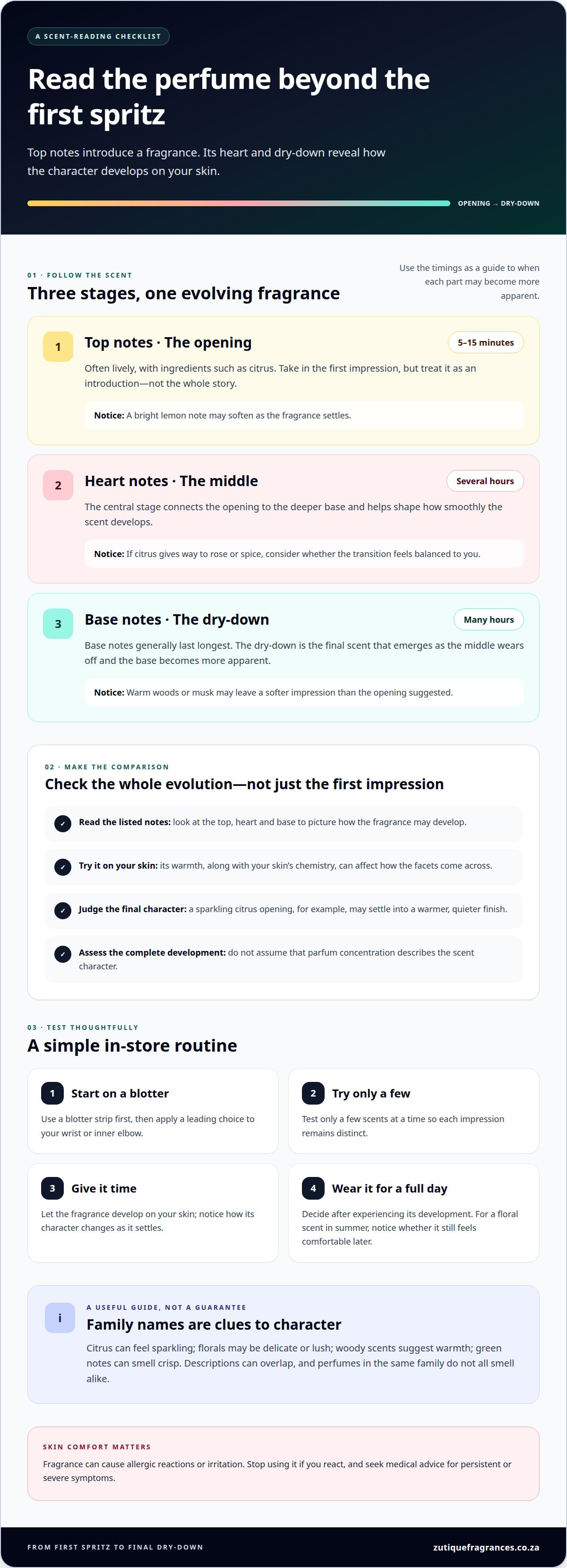
- Start with the family that draws you in. Perfumes are grouped into eight olfactive families, though descriptions can overlap. Citrus scents feel sparkling; florals may be delicate or lush; woody fragrances suggest warmth, whilst green notes can smell crisp. “Oriental” is a traditional family label often associated with rich, warm accords. Treat these descriptions as clues to character, not guarantees that every perfume in a family smells alike.
- Choose a signature scent or build a wardrobe. A signature scent gives you one familiar fragrance to return to across occasions. A fragrance wardrobe offers variety, such as a fresh composition for daytime and a deeper choice for evenings. If you’re considering how to choose a perfume for regular wear, decide whether simplicity or variety suits your habits. Let your scent profile guide you, rather than feeling obliged to follow a formula.
- Match intensity to the occasion. For everyday wear, consider a balanced fragrance that feels comfortable through work or errands. A celebration might call for a more distinctive character. To understand how to choose a perfume for a particular moment, read the notes and imagine their effect, rather than relying on the family name alone. Top notes shape the opening, but the scent that follows matters too.
- Give a candidate time on your skin. Apply it to a pulse point and notice how its character changes as it settles. Your skin’s warmth can reveal facets beyond the first impression, including the fragrance’s lasting character. Compare this development with the listed notes before deciding. To explore perfumes by character, browse the fragrance selection as you refine your preferences.
Perfume notes and how they develop
Follow a perfume from its bright opening to its quieter dry-down. The same fragrance can reveal different facets as its notes unfold.
- Notice the top notes first. These create the opening impression, often with lively ingredients such as citrus. Top notes typically last from 5 to 15 minutes, so treat that first burst as an introduction, not the whole story. A bright lemon note, for example, may soften as the fragrance settles. Take in the initial character, then give the perfume time before judging its overall appeal.
- Listen for the heart, or middle, notes. These terms describe the fragrance’s central stage, which can linger on skin for several hours. Heart notes connect the opening to the deeper base, influencing how smoothly the whole scent develops. If citrus gives way to rose or spice, notice whether that transition feels balanced to you. The middle can change the mood established by the first spritz.
- Consider the base notes and dry-down. Base notes generally last longest on skin and can remain for many hours. The dry-down is the final scent that emerges as the middle note wears off and the base becomes more apparent. Warm woods or musk may leave a softer impression than the opening suggested. Decide whether you enjoy this final character, not only the first minutes.
- Compare the notes with the fragrance’s full evolution. Read the listed top, heart and base notes, then notice how they interact on your skin. A perfume’s chemistry and your skin can influence the way its facets come across. For example, a sparkling citrus opening may settle into a warmer, quieter finish. If considering parfum, assess its complete development rather than assuming concentration describes its scent character. Let the whole sequence guide your choice.
Testing perfumes and buying online
Test fragrances methodically in store, or study their descriptions online before choosing. A thoughtful comparison helps you distinguish a fleeting first impression from a scent that suits you.
-
Test perfume on skin
Start with a blotter strip, then apply a leading choice to your wrist or inner elbow. Test only a few scents at a time so their impressions remain distinct. Let the fragrance develop on your skin and wear it for a full day before deciding. When testing floral scents for summer, notice whether they still feel comfortable later.
-
Compare perfume sizes and prices
Compare bottle size and listed price together instead of judging value by price alone. Perfume prices in South Africa vary with factors such as concentration, bottle size and brand, so one price range won’t suit every option. A smaller bottle may suit occasional wear; a larger one may make sense for a fragrance you already know.
-
Read online descriptions with care
Match the listed notes to your preferences before ordering. A description featuring citrus, for example, may suggest a brighter opening, while woods or musk can indicate a warmer impression later. Check whether the page gives the fragrance concentration, such as eau de parfum, and bottle size. These details help you compare options, even when you can’t smell the perfume first.
-
Choose a reputable source
Buy from a retailer that clearly identifies the fragrance, its size and its concentration. These details help you make an informed choice about authenticity, though a polished description alone can’t establish it. For an online option in South Africa, browse perfumes and fragrances and compare the details with your scent preferences before selecting.
Zutique Fragrances: Perfumes and Fragrances
Zutique Fragrances offers perfumes and fragrances to help you find your next scent. Once you’ve explored fragrance families and identified notes you enjoy, browse the range with your preferences in mind. Look for descriptions that match the character you want, whether that’s a fresh everyday fragrance or a more expressive scent for a special occasion.
Choosing a perfume is personal, and a shortlist can help you focus on the details that matter: scent family, listed notes and fragrance type. Use these clues to compare options and find a fragrance that feels aligned with your style. If you’d like to discuss your perfume choice, contact Zutique Fragrances.
Make Your Next Scent Choice Personal
Learning how to choose a perfume is less about following a formula and more about recognising what feels right to you. Let your preferences guide your next discovery, whether you’re looking for an everyday favourite or a fragrance for a special moment. You don’t need to choose a lifelong signature scent straight away. Each thoughtful choice can reveal more about the aromas, moods and memories you’re drawn to.
As you browse, trust the details that resonate with you and give yourself room to explore. A fragrance can become part of how you express your individuality, quietly or boldly, in a way that feels entirely your own. For help with your next step, contact Zutique Fragrances for scent advice.
Enjoy exploring, and choose the scent that makes you feel most like yourself.
Frequently Asked Questions
Can it change over time?
A perfume can smell different as it settles on your skin, and the same fragrance may seem different in another setting. Your first impression is only part of the experience. For a fair comparison, try the scent under similar conditions on separate days, such as before work, rather than judging it after a rushed spritz in a busy shop.
Eau de Parfum, Eau de Cologne, and Eau de Toilette: What’s the Difference?
The main difference is fragrance concentration. Eau de Cologne typically contains 3-5% essential oils, Eau de Toilette 5-15%, and Eau de Parfum 15-25%. These ranges can help you compare product labels, but they don’t tell you whether the scent itself will suit your taste. For instance, a bright citrus fragrance may appeal to you more than a richer floral, whatever its concentration.
How do you make the selection?
Start with the impression you want to create, then narrow your options by notes and fragrance family. For work, you might prefer a scent that feels comfortable in close company; for a celebration, you may want something more expressive. Compare a shortlist rather than browsing without direction, and choose the fragrance whose character feels most natural to wear.
What Are Fragrance Notes?
Fragrance notes describe a perfume’s scent and character. A description might mention bergamot, rose or vanilla, helping you picture its aromatic style before smelling it. Treat these notes as a guide to the overall composition, not a promise that one ingredient will dominate. If you enjoy rose in a candle, for example, that can be a useful clue when exploring perfumes.
What is a scent profile?
A scent profile is a personal snapshot of the fragrance qualities you tend to enjoy. It might include fresh, green smells or warmer accords such as amber and spice. It’s not a fixed label or a rule for future choices. Use it to compare descriptions, while staying open to an unexpected note that catches your interest.
What is the most important note: top, middle, or bottom?
No single note matters most for everyone. The opening may matter if you want an immediate, bright impression, while the dry-down may matter more if you want a fragrance you’ll enjoy wearing for longer. Think about when you’ll wear it and what you want to notice. The right priority is the part of the perfume that best suits that purpose.
